Texas caps ODL driving at 12 hours per day, but the real constraint isn't the cap—it's how judges document the approved window in your court order, and what happens when your shift pattern doesn't fit their template.
The 12-Hour Cap Versus Your Actual Approved Hours
Texas Transportation Code caps Occupational Driver License (ODL) driving at 12 hours in any 24-hour period, but that statutory ceiling is not your actual approved window. Your court order specifies the hours you can legally drive, and those hours must be narrower than the 12-hour cap. Most county courts write time restrictions as fixed blocks: "6:00 a.m. to 6:00 p.m. Monday through Friday" or "7:00 a.m. to 7:00 p.m. daily." That fixed-block framing works cleanly for salaried employees with predictable shifts. It creates approval friction for swing workers, commissioned salespeople, gig drivers, and anyone whose work hours vary by week or by client schedule.
The 12-hour cap applies separately each calendar day. If your order permits driving from 6:00 a.m. to 6:00 p.m., you cannot extend that window to 8:00 p.m. on a Tuesday because you only drove two hours on Monday. The cap does not roll over. Each day resets. The statutory cap exists to prevent all-day unrestricted driving under ODL cover, but the court's enumerated hours in your order are the binding restriction you must follow.
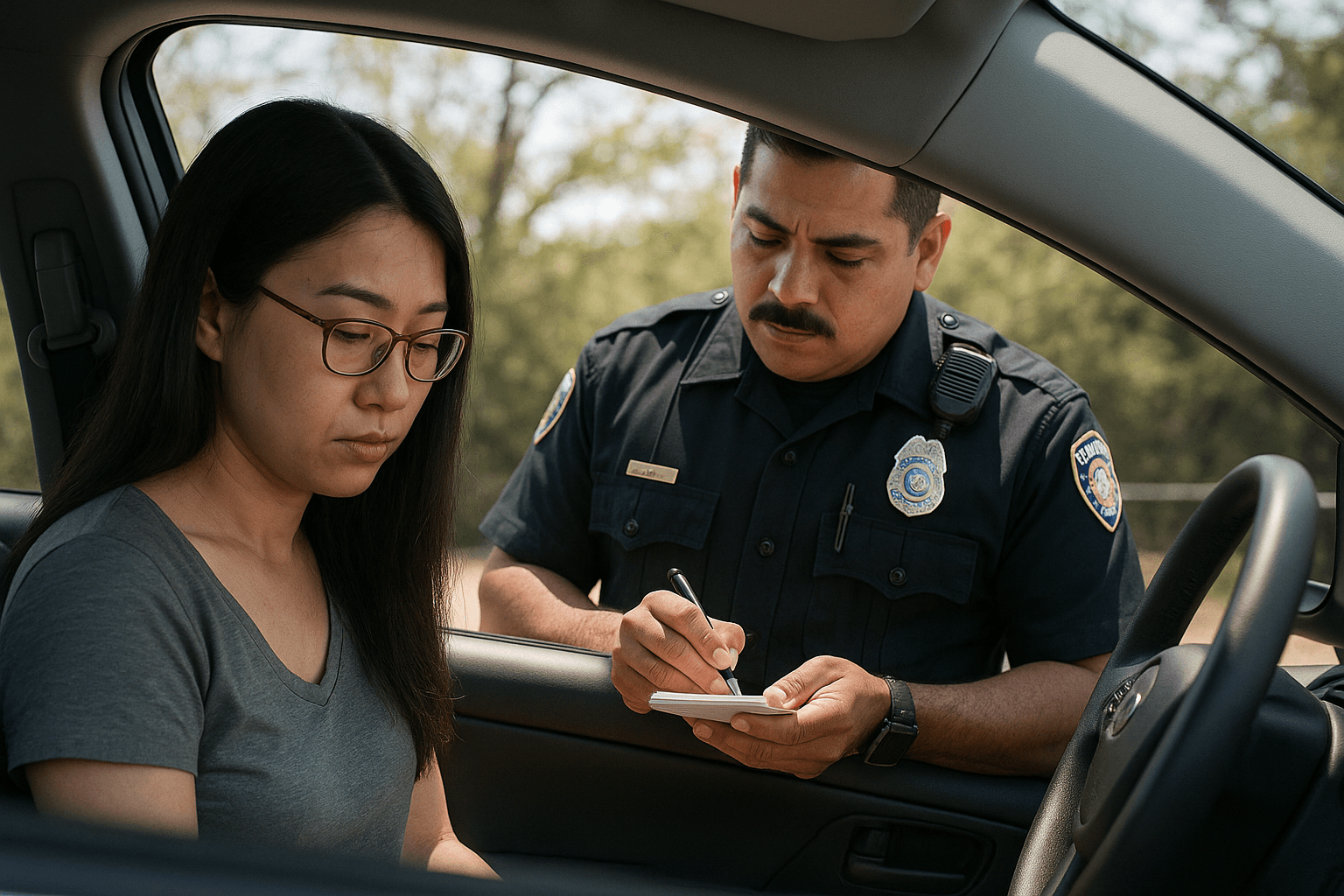
Texas DPS officers enforce the court order, not the statutory cap. If your order says 7:00 a.m. to 5:00 p.m. and you are stopped at 5:30 p.m., the fact that you are still under 12 hours of total driving that day does not matter. You are outside your approved window. That stop triggers an ODL violation, which most county courts treat as automatic revocation grounds without a hearing.
How County Courts Document Work Hours in the Order
The ODL petition requires you to submit employer verification documentation proving your work schedule and essential need. Most employers provide a letter stating job title, work address, typical shift hours, and a confirmation that driving is required to reach the workplace. County courts convert that employer letter into a time-restriction clause in the court order, and the way that clause is written determines your actual legal driving window.
Judges typically write time restrictions in one of three formats. Fixed daily blocks: "Permittee may drive between 6:00 a.m. and 6:00 p.m. Monday through Saturday for work purposes." This is the most common format and the easiest to enforce, but it does not accommodate variable shift patterns. Named-purpose windows: "Permittee may drive to and from work, and during work hours for job-related duties, provided total driving does not exceed 12 hours per day." This format gives flexibility for sales routes or job-site travel but requires you to carry documentation proving the driving was work-related if stopped. Enumerated-route time blocks: "Permittee may drive from residence at 123 Main St to workplace at 456 Commerce Blvd between 7:00 a.m. and 8:00 a.m., and from workplace to residence between 5:00 p.m. and 6:00 p.m." This is the most restrictive format and the hardest to modify if your shift changes.
If your work hours vary weekly or you work multiple job sites, you need the named-purpose window format in your order. That requires your employer letter to state that job duties require driving during variable hours rather than a fixed shift schedule. Some county courts resist named-purpose language because it is harder for officers to verify compliance during a traffic stop. You may need to negotiate with the court or provide additional documentation showing why a fixed block cannot accommodate your job requirements.
Compare car insurance rates in your state
Get quotes from licensed carriers — no obligation, no spam, results in minutes.
Get Your Free Quote✓ No Obligation Required✓ Licensed Carriers Only✓ Available Nationwide✓ Free to Compare
What Happens When Your Shift Changes After Approval
Your ODL is valid only for the hours and routes documented in the court order. If your employer changes your shift from 8:00 a.m. to 5:00 p.m. to 10:00 a.m. to 7:00 p.m., and your order specifies the original hours, driving under the new schedule is a violation even if the total hours per day remain under 12. Texas does not allow administrative amendments to ODL time restrictions. You must return to the issuing court and petition for a modified order.
The petition-for-modification process requires a new employer verification letter documenting the changed shift hours and a filed motion with the court that issued the original order. Most counties do not charge a second filing fee for modifications if the original ODL is still active, but processing time typically runs two to four weeks. During that processing window, you are bound by the original order's hours. Driving outside those hours before the modified order is signed creates a violation record that can be used to revoke the ODL entirely.
Some employers will not provide shift-change verification letters because they view ODL holders as higher liability risks. If your employer refuses to document the new schedule, you cannot legally drive during the changed hours even if the job requires it. That refusal sometimes forces ODL holders to choose between violating the order to keep the job or losing the job by refusing shifts outside approved hours. Courts do not waive the documentation requirement based on employer refusal.
Gig Work and Non-Standard Employment Under ODL Restrictions
Gig drivers, freelancers, and commissioned workers face the highest approval friction because their work hours do not fit the fixed-block template most courts use. Uber, Lyft, DoorDash, and Instacart work requires the ability to drive during variable hours across multiple days, and most county courts will not issue named-purpose windows broad enough to cover on-demand gig schedules. Texas statute does not exclude gig work from ODL eligibility, but the court's discretion to define "essential need" means approval depends on how the petition frames the work.
If you work gig shifts, your petition must argue that the gig income is your primary source of household support and that no fixed-shift alternative employment is available in your skill set or geographic area. Attach income documentation showing consistent gig earnings over at least 90 days before the suspension. Some courts will approve a named-purpose ODL for gig work with a daily 12-hour cap and a requirement to carry the court order plus weekly earnings records during every trip. Other courts deny gig petitions outright on the theory that gig work is discretionary rather than essential.
Multiple-job scenarios create similar friction. If you work two part-time jobs with non-overlapping shifts, your petition must list both employers, both addresses, and request time windows that cover both commutes and both shift blocks. Courts sometimes approve dual-employer ODLs but require separate verification letters from each employer and enumerated routes for each job. The more complex the schedule, the higher the risk the court denies the petition and directs you to consolidate employment into a single fixed-shift job before reapplying.
What Documentation You Need to Carry While Driving
Every ODL holder in Texas must carry the signed court order, a valid ODL physical license issued by DPS, and an SR-22 certificate of financial responsibility during every trip. If your order uses named-purpose language rather than fixed time blocks, you should also carry employer verification documentation proving the trip you are making falls within approved purposes. That documentation can be a work schedule printout, a delivery manifest, or a supervisor contact number the officer can call to verify your shift.
Officers enforce ODL restrictions by comparing the stop time and location to the hours and routes in your court order. If your order says you can drive to and from work between 7:00 a.m. and 6:00 p.m., and you are stopped at 7:30 p.m. two miles from your workplace, the officer will ask why you are still driving. "I stayed late to finish a project" is not a defense unless your court order includes language permitting variable work hours. Without that language, the stop is a violation.
Some county courts include a clause in the order requiring ODL holders to keep a driving log documenting every trip's purpose, start time, end time, and odometer reading. That log requirement is enforceable, and failure to produce the log during a stop can be treated as a violation even if the trip itself was within approved hours. Check your court order for log-keeping language. If the order requires it, maintain the log daily and carry it in the vehicle.
SR-22 Filing and Insurance Setup for ODL Holders
Texas requires SR-22 financial responsibility filing for every ODL holder, regardless of the suspension cause. The SR-22 must be active before DPS will issue the physical ODL card, and it must remain active for the entire suspension period plus any additional filing period required by statute. For DWI-related suspensions, SR-22 filing typically extends two years from reinstatement. For other causes, the filing period varies.
You need a Texas-licensed carrier willing to write a policy for a suspended-license driver and file the SR-22 with DPS on your behalf. Non-standard carriers writing in Texas include GAINSCO, Dairyland, Bristol West, and Direct Auto. Monthly premiums for ODL holders typically run $140 to $210 depending on the suspension cause, vehicle, age, and county. The SR-22 filing fee itself is usually $25 to $50, paid once at policy setup.
If you do not own a vehicle, you need non-owner SR-22 coverage. Non-owner policies provide liability coverage when you drive a vehicle you do not own, and the carrier files the SR-22 the same way as a standard policy. Monthly premiums for non-owner SR-22 typically run $50 to $90. GAINSCO, Dairyland, and The General write non-owner policies in Texas. Your ODL court order does not change based on whether you have a standard or non-owner policy, but the non-owner policy will not cover you if you regularly drive a household vehicle—carriers define "regularly" as more than 12 days per month.