California's restricted license allows overnight work driving, but most second-shift employees make one documentation mistake that triggers denial: their employer letter doesn't specify post-midnight hours or return-trip timing.
Why California's Restricted License Works for Second-Shift Drivers
California does not impose blanket time-of-day restrictions on its restricted license. Unlike states with hard curfews (typically midnight to 5 a.m.), California limits driving by purpose, not by clock. If your work shift ends at 2 a.m., and your employer documents that schedule, you can drive home legally at 2:30 a.m. under your restricted license.
The restriction is functional: driving to and from work, to and from your DUI treatment program if applicable, and within the scope of your employment if your job requires driving. The DMV does not pre-approve your route or hours. Instead, enforcement happens if you are stopped: you must demonstrate that your trip at that moment serves an approved purpose.
This structure favors second-shift workers in industries like healthcare, warehousing, hospitality, and manufacturing, where overnight schedules are standard. But it creates a documentation burden most applicants miss.
The Employer Letter Must Specify Post-Midnight Hours
California requires proof of employment and work schedule as part of your restricted license application. Most employers provide a generic verification letter: name, title, hire date, full-time status. That letter will not satisfy the DMV for overnight driving purposes.
Your employer letter must state: (1) your exact shift start and end times, including a.m. or p.m. designation, (2) the specific days of the week you work those hours, and (3) your workplace address. If your shift crosses midnight (for example, 10 p.m. to 6 a.m.), the letter must show both the departure time from home and the return time after shift end. The DMV needs to see that your 3 a.m. drive home is not discretionary travel but the direct result of your documented work schedule.
Many second-shift applicants submit letters that say "works evenings" or "night shift as needed." The DMV interprets vague timing as discretionary and denies the application. Reapplication costs another $125 and resets your timeline by weeks.
Compare car insurance rates in your state
Get quotes from licensed carriers — no obligation, no spam, results in minutes.
Get Your Free Quote✓ No Obligation Required✓ Licensed Carriers Only✓ Available Nationwide✓ Free to Compare
Route Documentation for Overnight Commutes
California does not require pre-filed route maps, but if you are stopped while driving under a restricted license, law enforcement will ask where you are going and why. Your answer must align with your approved purposes. For second-shift workers, this means: (1) you left your home address at your documented shift start time, or (2) you are returning to your home address after your documented shift end time, or (3) you are driving during your shift for job-related purposes your employer verified.
If your shift ends at 2 a.m. and you stop for gas at 2:15 a.m. on the way home, that detour is defensible as incidental to your commute. If you stop at a bar, a friend's house, or a retail store at 2:15 a.m., you have violated your restriction. The restricted license does not allow errands, even urgent ones, unless they fall within the scope of employment or DUI program attendance.
Some overnight workers have variable shift end times (for example, dispatchers released when call volume drops). In those cases, your employer letter should state "shift ends between 1 a.m. and 3 a.m. depending on operational need" rather than a single fixed time. This gives you defensible coverage for the actual variability of your schedule.
Ignition Interlock Device Setup for Overnight Shifts
California requires an ignition interlock device (IID) on all DUI-related restricted licenses, including first offenses. The IID must be installed before the DMV will issue your restricted license. For second-shift workers, IID installation creates two logistical issues most applicants overlook.
First, IID providers operate during business hours. You must take time off work, or arrange installation on a day off, to get the device installed. Installation typically takes 60 to 90 minutes. Some providers offer Saturday appointments, but availability is limited and books weeks in advance. Budget two to three weeks from restricted license approval to IID installation to driving legally.
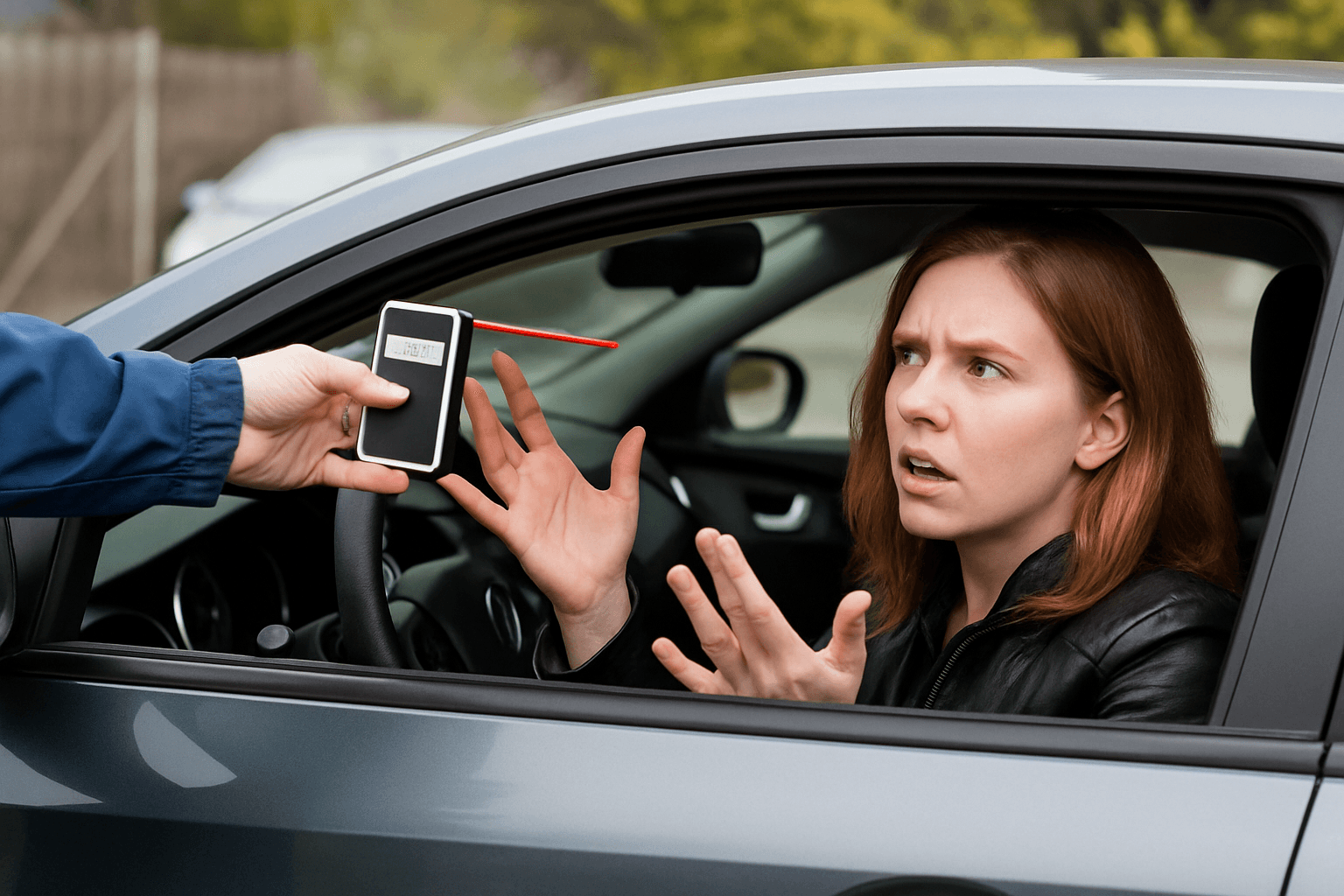
Second, IID devices require periodic "rolling retests" while the vehicle is running. The device will prompt you to blow into it at random intervals (typically every 5 to 15 minutes) after you start the car. If you do not provide a breath sample within the time window, the device logs a violation and may trigger an alarm. For second-shift commuters driving 30 to 60 minutes each way on highways, rolling retests are inevitable. Practice the retest process in a parking lot before your first overnight commute: you must be able to provide a breath sample without taking your eyes off the road for more than a glance.
SR-22 Filing and Premium Impact for Overnight Workers
California requires an SR-22 certificate of insurance filing for all restricted licenses following DUI or negligent operator suspensions. Your insurer files the SR-22 electronically with the DMV. The filing itself costs $15 to $25, but the premium increase is the larger cost. Drivers with DUI-triggered restricted licenses typically see monthly premiums rise to $180 to $320 per month for liability-only coverage, depending on age, county, and carrier.
Second-shift workers face a premium quirk: some carriers apply higher rates to drivers with non-standard commute hours, citing increased accident risk during overnight driving. This is not universal, but it appears in underwriting models at several non-standard carriers. When comparing quotes, confirm whether the carrier asks about your work schedule. If they do, provide accurate hours. Misrepresenting your commute window to avoid a surcharge creates a coverage gap: if you file a claim during hours you told the carrier you would not be driving, the claim may be denied.
SR-22 must remain on file for three years from your restricted license issue date. If your policy lapses or cancels, your carrier notifies the DMV within 24 hours, and your restricted license is suspended immediately. For second-shift workers who cannot afford a lapse, set up automatic payment and request your carrier send you a renewal notice 60 days before expiration, not 30.
What Happens If You Are Stopped Outside Approved Hours
Driving outside your restricted license purposes is a misdemeanor in California under Vehicle Code Section 14601.2. If you are stopped at 3 a.m. and cannot demonstrate that your trip serves an approved purpose, law enforcement will arrest you for driving on a suspended license. Your vehicle will be impounded, your restricted license will be revoked, and you will face criminal charges.
The most common violation scenario for second-shift workers: stopping for non-essential errands on the way home from work. A grocery store stop, a drive-through meal, a detour to drop off a friend—all are violations. The restricted license does not allow incidental stops unless they are genuinely incidental to your commute (for example, a red-light stop, a gas station visit because your tank is near empty). If the stop serves a separate purpose from getting to or from work, it is a violation.
Some second-shift workers assume that because California has no clock-based curfew, they have more freedom than daytime drivers. The opposite is true: overnight driving draws more scrutiny because fewer cars are on the road, and law enforcement knows that restricted licenses are common among overnight drivers. If you are stopped, you will be asked for proof of your work schedule and your destination. Carry a copy of your employer verification letter in your vehicle at all times.
Finding Coverage That Accepts Overnight Work Schedules
Most standard carriers will not write new policies for drivers with DUI suspensions. You need a non-standard carrier willing to file SR-22 and accept a restricted license. In California, carriers writing this coverage include Acceptance Insurance, Bristol West, Dairyland, Geico, Infinity, Kemper, National General, Progressive, and The General. Not all will quote overnight workers.
When requesting quotes, confirm three details with each carrier: (1) they file SR-22 in California, (2) they accept restricted licenses with IID requirements, and (3) they do not exclude coverage during overnight hours. Some carriers apply time-of-day exclusions to high-risk policies. If your policy excludes coverage between midnight and 5 a.m., and you work those hours, you are uninsured during your commute. That violation will trigger a new suspension.
Expect the quoting process to take longer than a standard policy. Non-standard carriers often require manual underwriting for restricted license cases. Request quotes from at least three carriers and allow five to seven business days for responses. If you need coverage immediately and cannot wait, Geico and Progressive typically provide same-day restricted license quotes online, though their rates are not always the lowest.