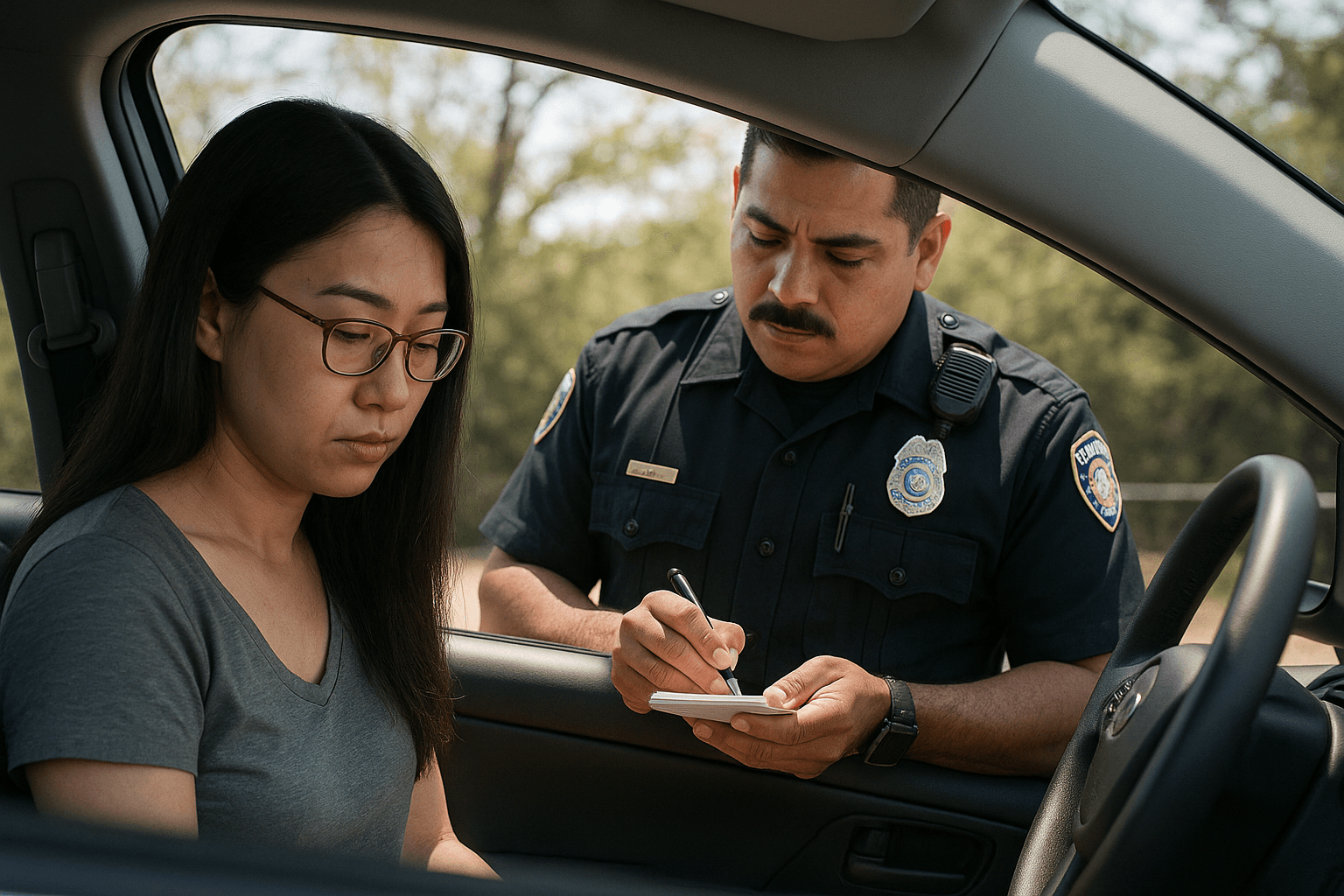
Texas retail workers filing for Occupational Driver Licenses face unique shift-documentation challenges: non-standard hours, unpredictable schedules, and employer hesitation to define routes in writing. Here's what actually satisfies judges and DPS.
Why Retail Shift Work Complicates Texas ODL Documentation Requirements
Your license was suspended and you stock shelves, run a register, or manage floor operations for a retail employer. Your schedule rotates. Some weeks you open at 5 a.m., other weeks you close at midnight. The court requires an employer affidavit stating your work hours and commute route before it will grant an Occupational Driver License. Your manager looks at the form and hesitates—your hours change every two weeks.
Texas Transportation Code §521.242 requires the court order specify the times and routes for essential-need driving. The statute does not contemplate rotating shift schedules, fluctuating part-time hours, or on-call assignments. Most retail employers write schedules two weeks out, not the fixed Monday-Friday 9-to-5 structure judges expect. When your petition lands on the docket without concrete start and end times, the judge denies it. You lose the job before you can refile with corrected documentation.
The workaround requires your employer to state the broadest possible commute window that covers all potential shifts. If you work opening shifts starting at 5 a.m. and closing shifts ending at midnight, the affidavit requests driving authorization from 4:30 a.m. to 12:30 a.m. seven days per week. You are not authorized to drive those full hours every day—only during the specific shifts your employer schedules within that approved window. Texas courts accept this framework when the petition explicitly states the variable-schedule justification and attaches a sample two-week rotation as evidence.
What the Court Order Actually Needs From Your Retail Employer
The employer affidavit must include: your full legal name as it appears on your suspended license, the business name and physical address, your job title, a statement that driving to and from work is essential to continued employment, the earliest possible shift start time across all rotations, the latest possible shift end time across all rotations, the number of days per week you work (even if variable), and a signature from a manager authorized to verify employment. Most affidavits fail because they state current hours only—"currently scheduled Tuesday and Thursday 2 p.m. to 9 p.m."—without acknowledging the rotation.
Texas judges want assurance you are not requesting blanket authorization to drive whenever you want. The petition should attach a sample schedule showing the rotation pattern. If your store operates 6 a.m. to 11 p.m. and you are scheduled across opening, mid, and closing shifts on a rotating basis, the affidavit states: "Employee works variable shifts between 6 a.m. and 11 p.m., scheduled on a rotating two-week basis, typically four to five days per week." This signals structure without claiming fixed hours.
Some county courts in Harris, Dallas, Tarrant, and Bexar require the employer affidavit be notarized. Others accept unnotarized letters on company letterhead. Confirm local requirements with the clerk before filing. If your employer refuses to provide the affidavit because HR policy prohibits involvement in legal proceedings, the court will deny your petition. No affidavit, no ODL. This is the most common failure point for retail workers.
Compare car insurance rates in your state
Get quotes from licensed carriers — no obligation, no spam, results in minutes.
Get Your Free Quote✓ No Obligation Required✓ Licensed Carriers Only✓ Available Nationwide✓ Free to Compare
Route Documentation When You Work Multiple Store Locations
Retail workers assigned to multiple store locations face an additional documentation burden. Texas ODL orders must specify permitted routes, not just approved times. If you work three stores within a 15-mile radius on a rotating basis, the petition must list each store address and request authorization for commute routes between your residence and all three locations.
The court will not approve a general geographic radius. You cannot petition for "driving within Collin County for work purposes." Each destination address must appear in the order. If your employer rotates you to a fourth location after the ODL is issued, you are not authorized to drive there unless you file an amended petition and the court modifies the order. Driving to the unauthorized location violates the ODL restrictions and triggers automatic revocation under Texas Transportation Code §521.252.
Some retail employers provide company vehicles for inter-store travel during shifts. If you drive a company vehicle between locations during your shift but use your personal vehicle only for the home-to-work commute, state that distinction clearly in the petition. The ODL authorizes your personal vehicle only. Driving the company vehicle during work hours does not require ODL coverage if the employer maintains commercial liability insurance that covers you as a permissive driver. Confirm this with your manager before assuming coverage.
SR-22 Filing Setup for Retail ODL Holders in Texas
Every Texas ODL holder must maintain an SR-22 certificate of financial responsibility throughout the restriction period, regardless of the reason for suspension. There are no exceptions. The SR-22 must be filed before you apply for the ODL—the court will not issue the order without proof of SR-22 on file with DPS.
If you own the vehicle you drive to work, you need an owner SR-22 policy. If you do not own a vehicle and borrow a family member's car or plan to purchase one after reinstatement, you need a non-owner SR-22 policy. Non-owner SR-22 covers you as a driver across any vehicle you operate with permission. Most retail workers filing for ODL choose non-owner policies because they cost less than owner policies when the driver carries a suspension on record.
SR-22 filing fees typically run $25 to $50 as a one-time charge. The monthly premium impact is the larger cost. Texas retail workers with clean records before suspension typically pay $85 to $140 per month for non-owner SR-22 coverage. DUI-related suspensions push premiums to $140 to $220 per month. Estimates based on available industry data; individual rates vary by age, county, violation details, and carrier underwriting.
The SR-22 requirement lasts for the full restriction period, which for most DUI-related ODL cases is three years from the conviction date. If the SR-22 lapses for any reason—you miss a payment, the carrier cancels the policy, you switch carriers and the new carrier delays filing—DPS receives an SR-26 notification of lapse within 10 days. Your ODL is automatically suspended. The court does not grant a grace period.
Ignition Interlock Requirements for Alcohol-Related Suspensions
Texas requires ignition interlock devices on all ODLs issued for DWI-related suspensions under Transportation Code §521.2476. If your suspension stems from DWI arrest, DWI conviction, or Administrative License Revocation for failing or refusing a breath test, the court order will mandate IID installation before you can drive under the ODL.
IID installation costs $70 to $150 upfront. Monthly monitoring and calibration fees run $60 to $90. The device requires you to provide a breath sample before the vehicle starts and at random intervals while driving. If you fail a rolling retest, the device logs the violation and reports it to DPS. Three failed retests in a 12-month period trigger ODL revocation.
Retail workers opening stores at 5 a.m. sometimes fail rolling retests due to residual alcohol from the night before, even when they stopped drinking 10 hours earlier. The IID threshold is typically .025 BAC, far below the .08 legal limit. If you work opening shifts and consume alcohol off-duty, plan a minimum 12-hour gap between last drink and first ignition attempt. The device does not care about your work schedule.
IID is not required for non-alcohol suspensions: points accumulation, uninsured driving, unpaid tickets, child support arrears. If your suspension cause does not involve alcohol, confirm with your attorney that the petition does not request IID as a condition. Some judges impose IID as a blanket condition on all ODL orders regardless of cause. Challenge this if your suspension is unrelated to alcohol.
What Happens If Your Schedule Changes After the ODL Is Issued
Your ODL order specifies approved driving hours: 4:30 a.m. to 12:30 a.m. to cover your rotating retail shifts. Your employer cuts your hours and moves you to a strict Monday-Friday 9 a.m. to 5 p.m. schedule. You are still authorized to drive during the broader window stated in the order. The court does not require you to file an amendment when your hours contract within the approved range.
The opposite scenario creates risk. If your employer promotes you to assistant manager and schedules you for overnight inventory shifts from 11 p.m. to 7 a.m., and your current order only authorizes driving from 4:30 a.m. to 12:30 a.m., you are not covered for the 11 p.m. to 4:30 a.m. window. Driving during unauthorized hours violates the ODL. You must file an amended petition and obtain a modified court order before working the new shift.
Some retail workers assume the 12-hour daily driving cap under Texas law means they can shift their approved window as long as total daily driving stays under 12 hours. This is incorrect. The cap is a ceiling, not a substitution rule. If your order says 6 a.m. to 10 p.m., you cannot drive 2 a.m. to 2 p.m. just because it totals 12 hours. The specific times in the order control.
Amending an existing ODL order requires filing a motion with the court that issued the original order, paying a filing fee, and waiting for a hearing date. Processing takes two to four weeks in most Texas counties. Plan for this lag if you accept a promotion or transfer that changes your commute hours.
Getting Coverage That Meets Texas ODL and SR-22 Requirements
Texas retail workers need liability coverage that meets state minimums: $30,000 per person for bodily injury, $60,000 per accident, $25,000 for property damage. These are floor requirements. Many employers require higher limits as a condition of continued employment, particularly for roles involving company vehicle use or customer transport.
Carriers writing employment-hardship SR-22 insurance in Texas include Dairyland, GAINSCO, The General, Progressive, and Bristol West. Not all carriers write non-owner policies; GAINSCO and Dairyland reliably offer non-owner SR-22 statewide. If you own a vehicle, expect broader carrier options but higher premiums.
Compare quotes from at least three carriers. Premium variation for the same coverage profile runs 40% to 60% between highest and lowest quotes. The carrier quoting lowest today may not renew at the same rate after six months. Retail workers on variable-income schedules benefit from carriers offering flexible payment plans: bi-weekly or per-paycheck billing instead of monthly lump sums.
Once you select a carrier, confirm the SR-22 filing reaches DPS before you file your ODL petition. The court clerk will verify SR-22 status with DPS during the hearing. If the filing has not processed, the judge denies the petition and you wait another two to four weeks for a new hearing date. Most carriers file SR-22 electronically within 24 to 48 hours of policy activation, but paper filings can take seven to ten days.