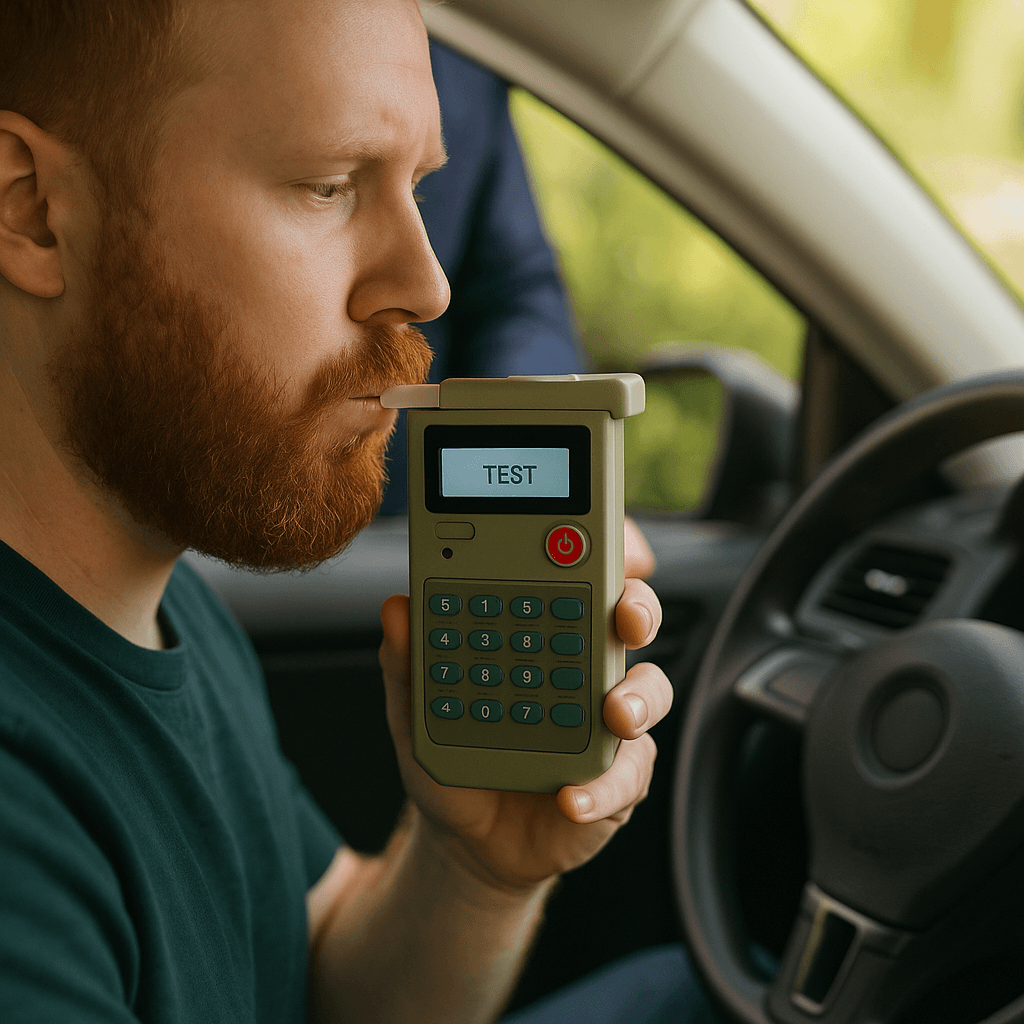
Your employer needs proof you're only driving during approved hours. The ignition interlock device logs every startup attempt, approved or not, and reports violations automatically to the state monitoring agency.
What the IID Actually Reports to State Monitoring Agencies
Every startup attempt is logged with a timestamp, GPS coordinates if your device includes location tracking, and breath test result. The device uploads this data to the state's monitoring agency automatically, typically every 30 to 60 days when you bring the vehicle in for calibration. Violations trigger immediately: any failed breath test, missed rolling retest, or startup attempt outside your approved driving hours generates an alert within 24 hours in most states.
The agency receives a full event log, not a summary. That log shows every time you turned the key, where the vehicle was located, what time it was, and whether you passed the breath test. If your work permit restricts driving to Monday through Friday, 7:00 AM to 6:00 PM, and the device logs a Saturday morning startup at 9:45 AM, that appears as a violation even if you passed the breath test.
Your employer does not receive automatic alerts. The state monitoring agency does not notify your workplace when you violate approved hours. The only entity that receives violation alerts is the court or DMV that issued your restricted license, and they decide whether to initiate revocation proceedings.
What Format the Compliance Report Actually Takes
Most IID providers generate a compliance summary at each calibration appointment. This is a printed or emailed document showing total startups, total violations, failed breath tests, missed rolling retests, and any tampering events during the calibration period. The format is provider-specific: Intoxalock, Smart Start, LifeSafer, and Guardian Interlock each use different templates.
The report does not break out approved-hours startups from unapproved-hours startups in a way most employers understand. The summary might show 47 total engine starts and 2 violations, but it won't clarify that violation 1 was a Sunday morning startup and violation 2 was a 10:30 PM weeknight startup, both outside your 6:00 PM cutoff. Employers expecting a simple yes/no compliance certificate are often confused by the multi-page event log format.
Some states require you to bring calibration reports to the court or probation officer managing your case. Florida, Texas, and Arizona explicitly mandate quarterly or monthly compliance report submission as a condition of maintaining your hardship license. Other states only pull the data when a violation alert triggers. Your work permit approval letter should state whether you are required to submit periodic proof of compliance to the court, but many approval letters omit this detail entirely.
Compare car insurance rates in your state
Get quotes from licensed carriers — no obligation, no spam, results in minutes.
Get Your Free Quote✓ No Obligation Required✓ Licensed Carriers Only✓ Available Nationwide✓ Free to Compare
How Employers Typically Verify You Are Following Restrictions
Most employers who agreed to provide a verification letter for your hardship application do not track IID compliance after the license is issued. They assume the court or DMV is monitoring you. If your job involves driving a company vehicle, fleet managers may ask for periodic proof you still hold a valid restricted license, but they rarely ask for IID compliance reports unless your role involves transporting clients, delivery driving, or commercial purposes.
If your employer does request proof of compliance, the calibration summary report is the only documentation you can provide. Courts do not issue separate compliance certificates. The state monitoring agency does not issue letters confirming you followed your approved hours. The only evidence is the IID provider's own calibration report, which your employer must interpret without guidance.
Some HR departments reject calibration reports because they do not explicitly state "employee complied with court-ordered restrictions." The report shows raw data: timestamps, test results, violation flags. If a violation appears anywhere on the report, even if it was later dismissed or explained to the court, HR may interpret that as noncompliance and terminate employment based on perceived license violation.
What Happens When the Device Logs a Startup Outside Approved Hours
The violation appears in the next data upload, typically within 48 hours of your next engine start. The monitoring agency reviews the event and determines whether it warrants action. Minor violations, defined differently by each state, sometimes trigger a warning letter rather than immediate revocation. In Texas, one unapproved startup is usually treated as a warning if you otherwise show consistent compliance; three violations within 30 days typically trigger a revocation hearing.
You will not know a violation was flagged until you receive notice from the court or DMV. The IID device itself does not display alerts or warnings when you start the vehicle outside approved hours. It logs the event silently. Some drivers discover violations only when their occupational license is revoked without prior warning, weeks after the unapproved startup occurred.
If the violation was genuinely an emergency or a scheduling misunderstanding, you can request a hearing to contest the revocation. Courts evaluate these requests case by case. Showing up to the hearing with documentation, an employer letter explaining the context, and a clean compliance record otherwise improves your chance of reinstatement, but outcomes vary widely by jurisdiction and judge.
How This Affects SR-22 Filing and Your Premium
The IID violation itself does not trigger an SR-22 filing requirement if you already hold SR-22 because of your underlying suspension cause. DUI, reckless driving, and uninsured suspensions typically require SR-22 for the full suspension period plus reinstatement period, regardless of whether you violate work permit terms. The IID violation extends your overall compliance timeline by adding new suspension time, which extends your SR-22 filing obligation proportionally.
Your carrier receives notice of the hardship license revocation when the state files a new suspension event on your driving record. Most nonstandard carriers that write SR-22 policies for restricted-license holders will not cancel your policy mid-term for a work permit violation, but they will apply a surcharge at renewal. That surcharge ranges from 15 percent to 40 percent depending on the severity of the violation and your overall driving record during the restricted period.
If you lose your hardship license entirely and cannot reinstate it, you still must maintain your SR-22 filing through the remainder of your suspension period. Letting the SR-22 lapse triggers a separate suspension for failure to maintain proof of financial responsibility, which stacks on top of your existing suspension and often resets the entire suspension clock to zero.
What To Do If You Need Compliance Documentation for Your Employer
Request a calibration summary report from your IID provider immediately after each calibration appointment. Most providers email the report within 24 hours; some hand you a printed copy at the appointment. Keep every report in a dedicated folder, digital or physical, so you can produce the full compliance history if your employer or the court requests it.
If your employer requires proof you are following approved hours and the calibration report format is too technical, ask your probation officer or the court clerk whether they can provide a compliance verification letter. Some courts will issue a brief letter confirming you have complied with IID and restricted-hours requirements as of a specific date, but this is discretionary and not all jurisdictions offer it.
If HR or your supervisor cannot interpret the IID report and threatens termination based on confusion, consider having your attorney or the IID provider's compliance department contact them directly to explain the report format. Many employment terminations during restricted-license periods stem from documentation misunderstandings rather than actual violations.