Your work permit says 'direct route to and from employment.' Most states never define what counts as direct. The ones that do measure it differently.
What 'Direct Route' Actually Means in Work Permit Language
Most hardship license orders say you can drive a direct route between home and work. The phrase appears in nearly every state's restricted license statute. What changes state to state is whether anyone defines what direct means.
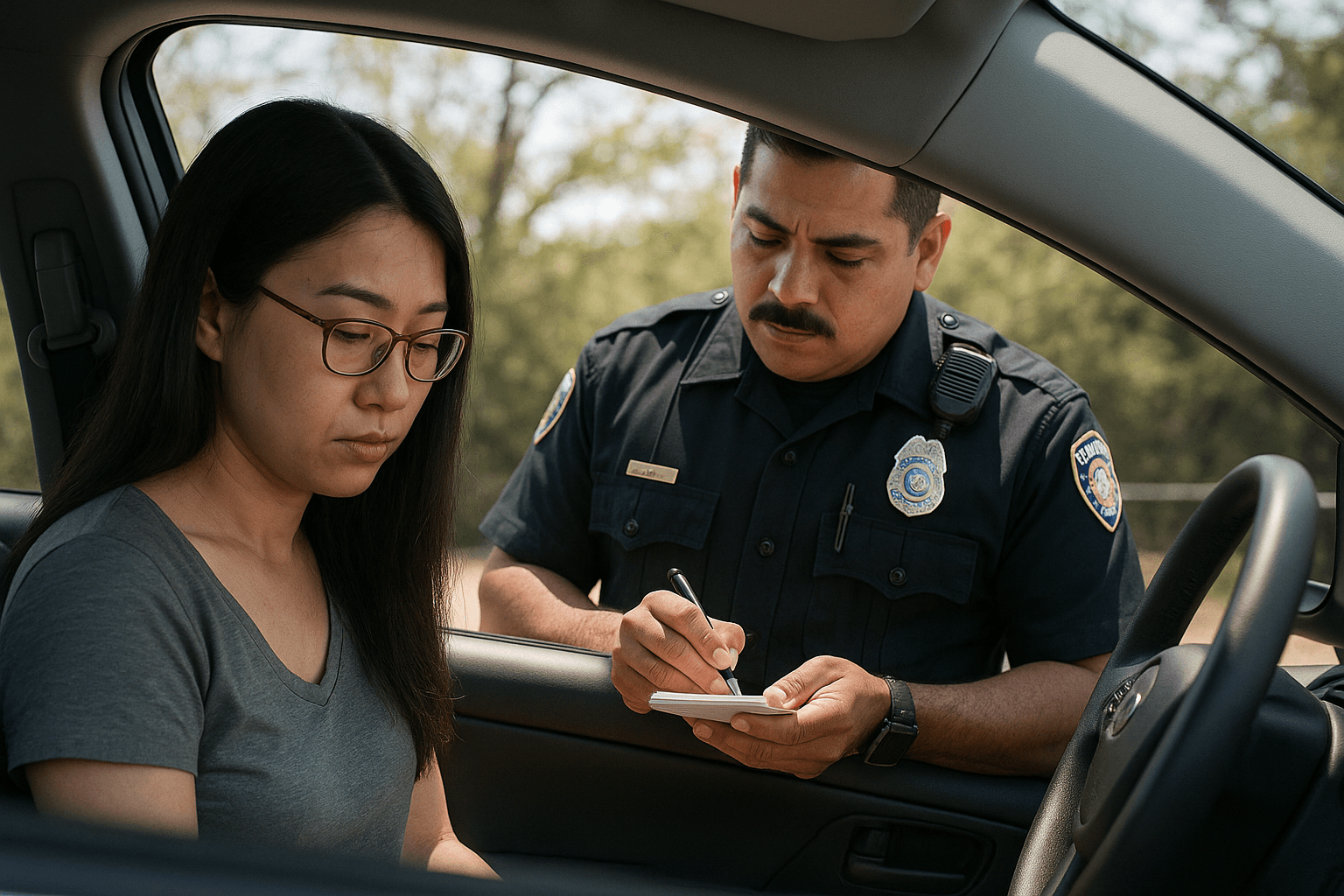
In most states, the restriction has no enforcement standard. Officers pull you over for something else and check whether you're on a plausible path during approved hours. If you are, you continue. If you're 15 miles off any reasonable commute corridor at 2 a.m., you get charged with driving on a suspended license even though you hold a work permit.
The states that do define direct route use three incompatible frameworks: shortest distance measured by odometer, shortest time measured by typical traffic conditions, or any route that does not include stops for personal errands. The first two sound similar but produce different legal outcomes when your shortest-distance route crosses a toll bridge and your shortest-time route does not.
The Three Enforcement Models States Use
States that enforce route restrictions actively fall into one of three models. The odometer model measures physical distance. If MapQuest shows 12.4 miles and your odometer shows 14.1 miles when you arrive at work, you drove outside your restriction. This is rare but it exists — Wisconsin uses it for OWI occupational licenses when the judge adds route specificity to the order.
The traffic-adjusted time model assumes you take the fastest route under normal conditions. If Google Maps shows 18 minutes via the highway and 24 minutes via surface streets, the highway is your approved route even if it's longer in miles. Illinois uses this framework for most Restricted Driving Permits tied to DUI. The permit itself does not spell this out — the Secretary of State's RDP FAQ does.
The errand-exclusion model does not care which physical route you take as long as you make no stops that are not work-related. You can take the scenic route. You cannot stop for groceries. Texas judges apply this standard for occupational licenses unless the order specifies otherwise. The statute says direct route; case law from *Ex parte Smith* (2003) defines it as 'without intervening personal purposes.'
Compare car insurance rates in your state
Get quotes from licensed carriers — no obligation, no spam, results in minutes.
Get Your Free Quote✓ No Obligation Required✓ Licensed Carriers Only✓ Available Nationwide✓ Free to Compare
What Counts as a Deviation and What Does Not
A deviation is any stop or route change that is not essential to completing the commute. Stopping for gas on the way to work is not a deviation in any state — your vehicle requires fuel to complete the essential purpose. Stopping for gas and then walking inside to buy a sandwich is a deviation in states using the errand-exclusion model.
Dropping your child at daycare on the way to work counts as a deviation unless your hardship order explicitly lists childcare as an approved purpose. Many states allow judges to add household maintenance or childcare to the approved-purposes list at the time the permit is granted. If the order does not list it, the stop is unauthorized even if it occurs on a direct geographic route between home and work.
Traffic detours do not count as deviations. If your usual route is closed due to construction and you take a signed detour, you remain within your restriction. If your usual route has heavy traffic and you choose an alternate route to save time, enforcement depends on which model your state uses. Under the time model, you are compliant. Under the odometer model, you may not be.
The Employer-Documentation Trap Most Drivers Miss
Most states require you to carry documentation proving your employment and your work hours any time you drive on a work permit. The typical documentation list includes a copy of your restricted license order, a letter from your employer on company letterhead stating your work address and shift times, and proof of SR-22 insurance filing.
The trap: your employer letter must match the hours and address on your hardship application exactly. If your application said you work 7 a.m. to 3 p.m. at 450 Industrial Parkway and your employer writes a letter saying you work 6:30 a.m. to 3:30 p.m. at 450 Industrial Parkway Suite B, an officer can cite you for non-compliance even though you are driving to the correct workplace during approved hours.
This matters most in states where the hardship order itself does not list your specific work address or hours — it just says 'employment purposes as documented in the application.' Georgia's Limited Driving Permit works this way. The permit card itself is generic. The application on file with the Department of Driver Services contains the enforceable restrictions. If what you tell an officer does not match what the DDS has on file, the officer writes the citation and you argue it in court later.
What Happens When You Get Pulled Over Outside Your Approved Route
If an officer pulls you over and determines you are driving outside your work permit restrictions, you are charged with driving on a suspended license. The work permit does not protect you. Most states treat this as a separate suspension-while-suspended offense, which carries higher penalties than the original suspension did.
In states where hardship licenses are granted by the court rather than the DMV, the judge who granted your permit can revoke it immediately upon notice of a violation. You do not get a hearing before revocation in most jurisdictions — the hearing comes after, when you petition for reinstatement. This is common in Texas, Oklahoma, and Kansas for occupational licenses tied to DUI.
Your SR-22 insurance does not lapse when your work permit is revoked, but your eligibility to drive does. If you continue driving on the now-revoked permit because you did not receive notice of the revocation, you are driving on a suspended license without a valid hardship exception. Most carriers will not defend you in this scenario even though your SR-22 filing remains active.
How to Set Up Insurance That Covers Work-Commute Routes
Your work permit requires SR-22 filing in most states. The SR-22 itself does not restrict where you drive — it just certifies that you carry liability coverage meeting your state's minimum requirements. Your employment hardship SR-22 policy must remain active for the entire duration of your suspension, even if your work permit is later revoked.
Non-owner SR-22 policies work for drivers who do not own a vehicle but need to drive an employer's vehicle or a borrowed vehicle for work purposes. The policy follows you, not the vehicle. Most non-owner policies cost $40–$70 per month depending on your violation history and state. If you own a vehicle, you need an owner SR-22 policy instead, which includes both liability coverage and the SR-22 certificate filing.
Some carriers exclude coverage for any driving that occurs outside your work permit restrictions. This is rare but it happens — the exclusion appears in the policy declarations under 'Limitations of Coverage' or 'Endorsements.' If your carrier includes this exclusion and you are later cited for driving outside your approved route, your claim may be denied even though your SR-22 filing was active at the time. Ask your agent whether the policy includes a work-purposes-only exclusion before you bind coverage.