Hawaii requires court petition for restricted driving privileges during suspension. The county-level system means application procedures, judicial discretion, and processing timelines vary by island—understanding your specific county's requirements is critical before filing.
How Hawaii's County Court System Controls Your Restricted License Application
Hawaii administers restricted driving privileges through county district courts, not a centralized state DMV. Honolulu County, Maui County, Hawaii County, and Kauai County each operate separate district court systems with different judges, filing procedures, and processing timelines. Your petition for work-driving privileges is heard by a district court judge on your island of residence—the Administrative Driver's License Revocation Office (ADLRO) handles administrative revocations separately but does not issue restricted licenses.
This county structure means practical variation in how judges evaluate petitions, what documentation they require, and how restrictive your approved driving conditions will be. A Honolulu County judge may approve broader work-hours windows than a Kauai County judge for identical employment circumstances. Processing times range from 2–6 weeks depending on court dockets and county staffing.
Before filing your petition, confirm which county district court has jurisdiction over your license. If you moved islands after your suspension, file in your current county of residence—Hawaii does not transfer restricted license petitions between counties mid-process.
What Work-Related Driving Hawaii Judges Typically Approve
Hawaii restricted licenses allow court-defined driving for work, school, medical appointments, and essential travel. The judge sets your approved purposes, hours, and routes at the time of issuance—these are not statutory defaults. Employment driving is the most commonly approved purpose, but you must prove the need with documentation.
Most judges approve commute-to-work driving plus on-the-job driving if your employment requires vehicle operation during work hours. Commission-based sales, delivery work, service calls, and client visits qualify if your employer letter confirms driving is a job function. Judges typically deny petitions from office workers whose job does not require driving beyond the commute.
Hawaii's island geography creates an implicit route boundary—you cannot drive between islands by road. Route restrictions are defined by specific addresses or geographic boundaries (e.g., home to workplace via specific highway corridors). Some judges require GPS logging or employer verification of arrival/departure times as a condition of approval.
Compare car insurance rates in your state
Get quotes from licensed carriers — no obligation, no spam, results in minutes.
Get Your Free Quote✓ No Obligation Required✓ Licensed Carriers Only✓ Available Nationwide✓ Free to Compare
Required Documentation for Your Hawaii Restricted License Petition
Hawaii requires proof of need, SR-22 insurance filing, and court petition forms at minimum. The specific documentation checklist varies by county court, but all four counties require an employer verification letter confirming your work need, hours, and job-related driving requirements.
Your employer letter must state your job title, work address, scheduled work hours, whether your job requires driving during work (not just commuting), and a manager contact name with phone number. Generic HR letters that omit specific driving requirements weaken your petition—judges deny applications when employment necessity is not clearly documented.
If your suspension resulted from a DUI or alcohol-related offense, you must also provide proof of Ignition Interlock Device (IID) installation before the court will approve restricted driving. Hawaii Revised Statutes §291E-41 mandates IID as a condition of any restricted license during DUI suspension—this is statutory, not discretionary. Medical appointments or school enrollment require similar verification: doctor's letter with appointment schedule or school enrollment confirmation with class hours.
Hawaii's Ignition Interlock Requirement for DUI-Related Suspensions
If your suspension resulted from DUI, implied consent refusal, or any alcohol-related driving offense, you must install an IID before filing your restricted license petition. Hawaii law requires IID installation as a precondition for restricted driving privileges during the entire suspension period—judges cannot waive this requirement.
You pay IID installation (typically $75–$150) and monthly monitoring fees (typically $65–$100/month) directly to the device provider. The provider submits compliance reports to the court and ADLRO monthly. If you violate IID conditions—attempting to start the vehicle with alcohol detected, missing a rolling retest, or tampering with the device—the provider notifies the court immediately and your restricted license is subject to revocation without additional hearing.
Hawaii does not operate a traditional points-based suspension system. License suspensions under HRS §286-111 are based on offense counts and conviction patterns, not accumulated point totals. This means if your suspension resulted from multiple moving violations rather than DUI, IID is typically not required—but verify with your county court clerk before assuming IID exemption.
Time and Route Restrictions Judges Impose
Hawaii judges set specific hours and routes at the time they approve your petition. These restrictions are written into your restricted license order and are legally binding—driving outside approved hours or routes is treated as driving on a suspended license, a separate criminal offense.
Most judges approve work commute hours with a 30–60 minute buffer before and after your shift. If your work hours are 8 a.m. to 5 p.m., your approved driving window might be 7 a.m. to 6 p.m. Judges rarely approve overnight driving windows unless you work night shifts with employer verification. On-the-job driving approval depends on whether your employer letter documents specific client visit requirements, delivery routes, or service call obligations.
Route restrictions are defined by address pairs or geographic corridors. Example: home address to work address via H-1 and Nimitz Highway only. Judges may allow one additional approved route for medical appointments or childcare if documented in your petition. Stops for fuel, food, or errands during your approved driving window are typically prohibited unless explicitly stated in the court order.
What Happens If You Drive Outside Approved Conditions
Driving outside your approved hours, routes, or purposes is prosecuted as driving on a suspended license, not a restricted license violation. Hawaii treats this as a separate criminal offense punishable by additional suspension time, fines up to $1,000, and potential jail time for repeat offenses.
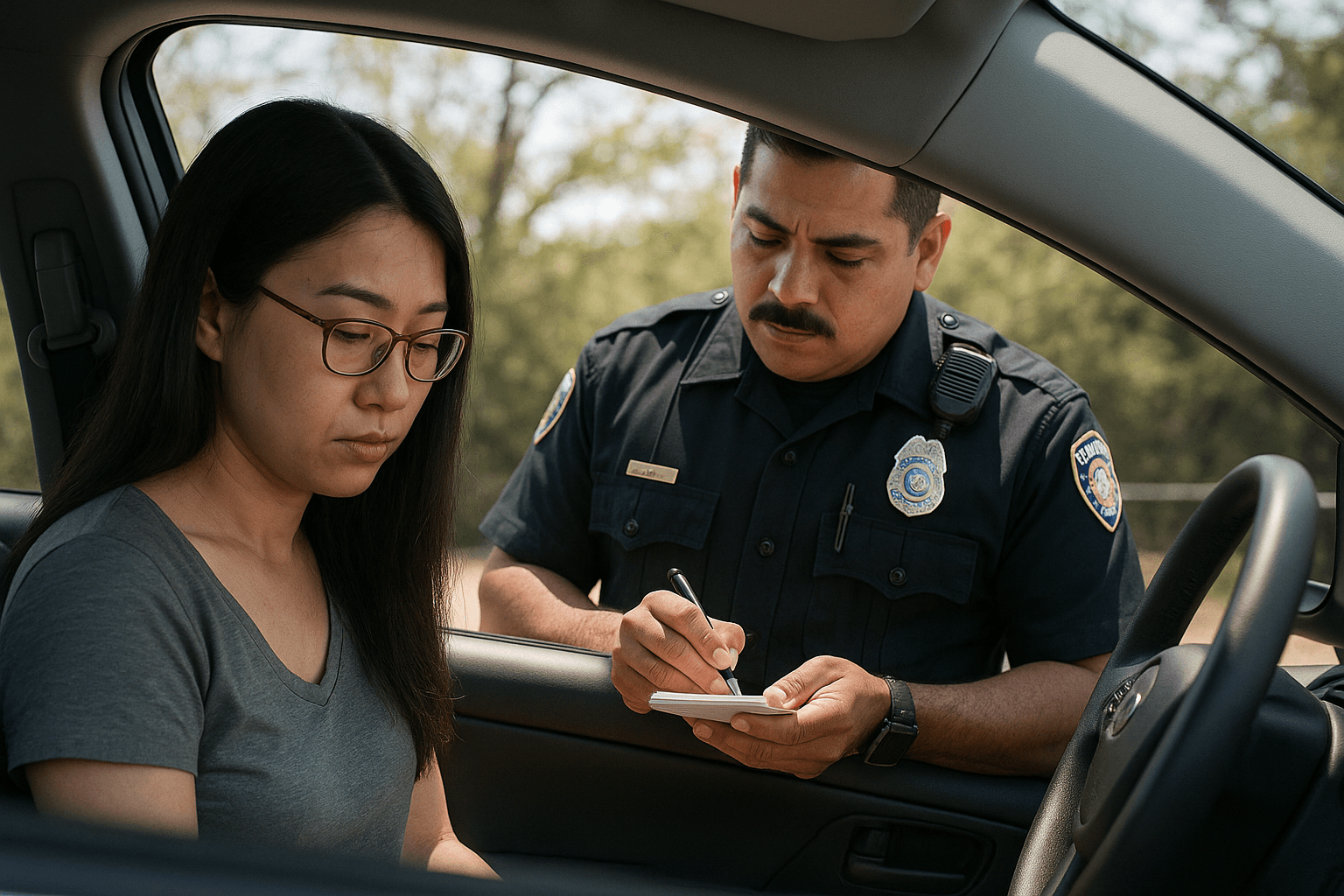
If law enforcement stops you outside your approved driving window, they verify your restricted license conditions on the spot. Hawaii's system allows officers to check your court-ordered restrictions in real time—there is no grace period if you are 10 minutes past your approved window or one mile off your approved route. The stop triggers an immediate citation and potential arrest.
Violating IID conditions—such as a failed rolling retest or tampering with the device—triggers automatic notification to the court and ADLRO. Most judges revoke restricted driving privileges after the first IID violation without requiring a separate hearing. You lose your work-driving ability and return to full suspension for the remainder of your original suspension period.
SR-22 Insurance Filing Setup for Hawaii Restricted Licenses
Hawaii requires SR-22 proof of financial responsibility filing for most restricted license cases, particularly DUI, uninsured driving, and repeat moving violations. Your insurer files the SR-22 certificate electronically with Hawaii's Motor Vehicle Safety Responsibility Act enforcement office under HRS Chapter 287.
SR-22 is not a separate insurance policy—it is a certificate your carrier files confirming you carry at least Hawaii's minimum liability limits: $20,000 bodily injury per person, $40,000 bodily injury per accident, and $10,000 property damage. Hawaii is a no-fault state, meaning you must also carry Personal Injury Protection (PIP) coverage—your SR-22 filing must confirm both liability and PIP compliance.
Not all carriers write SR-22 policies for suspended-license drivers. Based on Hawaii carrier filings, GEICO, Progressive, National General, State Farm, and USAA write SR-22 policies in Hawaii. Monthly premiums for SR-22 policies during suspension typically range $140–$240/month depending on your violation history and county. If you do not own a vehicle, you need a non-owner SR-22 policy covering liability and PIP—GEICO, Progressive, and USAA write non-owner SR-22 policies in Hawaii.
Cost Breakdown: Petition Filing, IID, SR-22, and Insurance
Your total cost to obtain and maintain a Hawaii restricted license includes court petition filing, IID installation and monitoring, SR-22 filing fee, and monthly insurance premiums. Court petition filing fees vary by county—Honolulu County charges approximately $30–$50, but verify current fees with your county district court clerk.
IID installation costs $75–$150 upfront, with monthly monitoring fees of $65–$100. Over a 12-month restriction period, total IID cost is approximately $930–$1,350. SR-22 filing itself is a one-time $25–$50 fee charged by your carrier, but the premium impact is ongoing—expect your monthly insurance cost to increase 40–80% compared to pre-suspension rates.
If you currently pay $100/month for auto insurance, expect SR-22 premiums of $140–$240/month during the restriction period. Over a 12-month restricted license term, total insurance cost is approximately $1,680–$2,880. Adding IID and court fees, total first-year cost is approximately $2,735–$4,280. This cost stack is unavoidable—judges will not approve restricted driving without proof of SR-22 and IID compliance.