Most states break the cost into four separate layers: the hardship application fee, ignition interlock installation and monthly lease, SR-22 filing fee, and the premium increase that follows your violation. The stack runs $2,400-$4,800 over the first year in most states, but employer verification failures and IID recalibration delays add hundreds more in hidden costs.
The Four-Layer Cost Structure Most Drivers Miss on First Application
Your drive-to-work permit cost splits into four distinct layers, each paid to a different entity at a different moment in the process. The application fee goes to your state's licensing agency when you submit the petition—typically $50-$150 depending on state. The ignition interlock device (IID) installation runs $75-$150 up front, then $60-$90/month for the duration of your hardship period if your violation triggers the IID requirement. The SR-22 filing fee is charged by your insurance carrier to submit the proof-of-insurance certificate your state requires—usually $25-$50 as a one-time filing cost. The premium increase is the ongoing monthly insurance cost after your violation is rated into your policy—typically adding $85-$190/month over a clean-record baseline.
Most drivers budget only the application fee because that is the number visible on the DMV hardship-license instruction page. The IID lease, SR-22 setup, and premium increase surface later in the process, often weeks apart, creating sticker shock that delays compliance. Judges reviewing hardship petitions in Texas, Georgia, and Illinois routinely deny first submissions when the employer verification letter lists only mileage reimbursement or fuel cost instead of acknowledging the compliance-layer costs the employee must carry to maintain the permit.
The total first-year stack runs $2,400-$4,800 in most states when all four layers are combined. DUI-trigger hardship cases in states requiring IID sit at the higher end. Points-accumulation or uninsured-driving cases without IID requirements sit at the lower end. Verify current requirements with your state DMV, as rules vary by jurisdiction and underlying violation.
Why Ignition Interlock Adds the Largest Hidden Cost
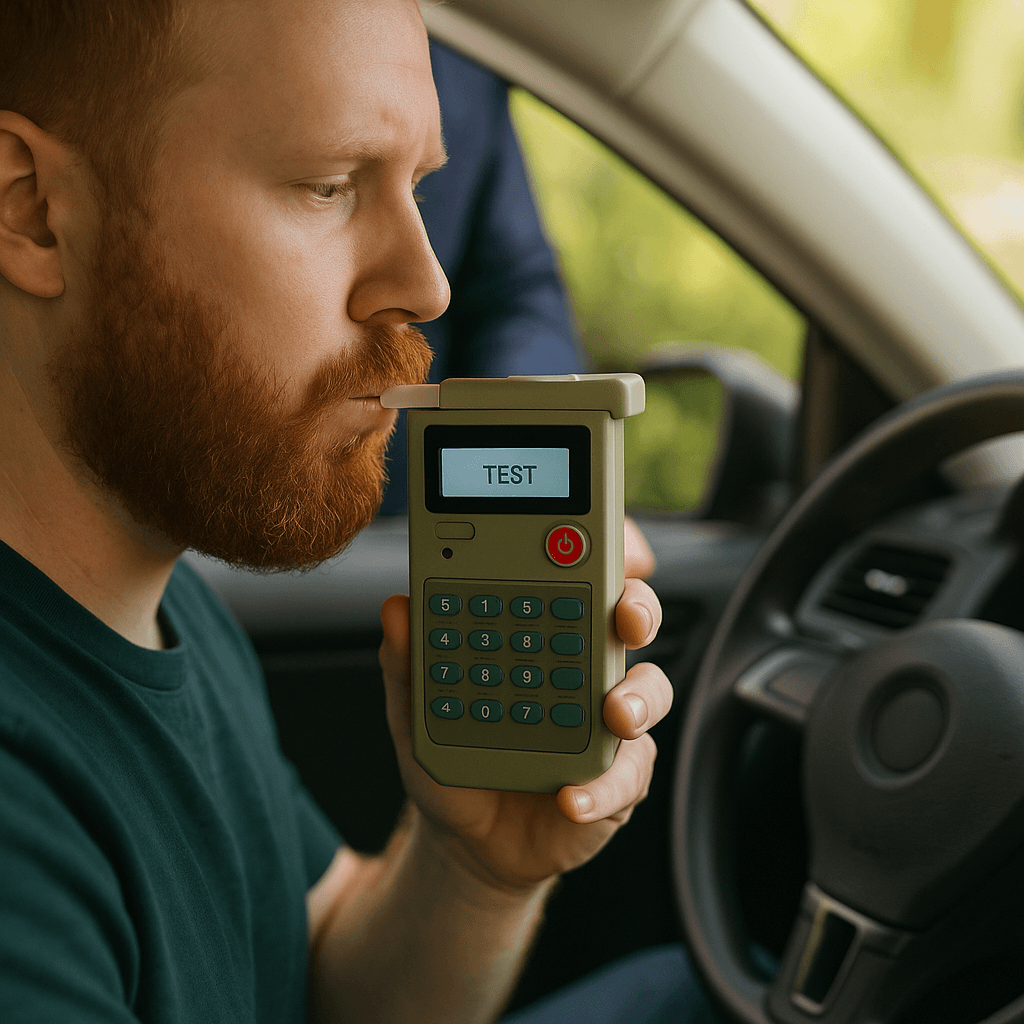
If your suspension was triggered by DUI, OWI, OVI, or wet reckless in most states, your hardship permit approval is conditioned on ignition interlock installation before the restricted license is issued. The device requires an upfront installation fee of $75-$150, then a monthly lease of $60-$90 that continues for the full duration of your hardship period—often 6-12 months minimum, sometimes longer depending on state and violation count. Texas occupational licenses tied to first-offense DUI require IID for the full restricted period. Illinois requires it for all alcohol-related hardship cases. Georgia does not mandate IID for first-offense hardship but requires it for second-offense or high-BAC cases.
The monthly lease is billed in advance. Miss a payment and the device locks you out of starting your vehicle, which means you cannot drive to work under your permit terms even if the permit itself remains valid. Recalibration appointments are required every 30-60 days depending on state and device provider. Each recalibration runs $10-$20 and must happen at a certified service center during business hours. Drivers who skip recalibrations trigger tampering alerts that are automatically reported to the state monitoring agency, often resulting in immediate hardship license suspension.
The IID layer alone adds $800-$1,200 to your first-year cost stack. Budget this separately from your insurance increase. Some IID providers offer payment plans, but the device lease cannot be skipped or delayed once installation is ordered by the court or DMV as a condition of your hardship approval.
Compare car insurance rates in your state
Get quotes from licensed carriers — no obligation, no spam, results in minutes.
Get Your Free Quote✓ No Obligation Required✓ Licensed Carriers Only✓ Available Nationwide✓ Free to Compare
SR-22 Filing Fee Versus the Premium Increase That Follows
The SR-22 filing fee is a one-time charge your insurance carrier bills to submit the certificate of financial responsibility your state requires. This fee typically runs $25-$50 and appears on your first bill after the carrier files the form with your state DMV. The filing itself is administrative overhead—it does not change your coverage limits or policy structure. Some carriers waive the filing fee entirely. Others charge it every time the SR-22 lapses and must be refiled.
The premium increase that follows your violation is the ongoing monthly cost and dwarfs the filing fee in total impact. After a DUI, uninsured-driving suspension, or reckless-driving conviction, carriers rerate your policy to reflect the elevated risk profile. This increase typically adds $85-$190/month depending on state, violation type, age, and driving history. The increase persists for the full SR-22 filing period—usually 3 years in most states, sometimes longer depending on violation count. Over a 3-year filing period at the midpoint of that range, the total premium increase runs approximately $4,300-$6,800.
Drivers applying for hardship permits often budget the $25 filing fee and miss the $140/month increase that follows. The filing fee is noise. The premium increase is the structural cost. When you request employer verification for your hardship petition, your employer needs to understand the ongoing monthly insurance cost, not just the one-time filing charge. Some employers provide mileage reimbursement or fuel allowances that can offset part of the insurance increase, but only if the employee documents the compliance cost accurately on the first petition.
What Happens When Your Employer Rejects the Hardship Verification Letter
Most states require an employer verification letter as part of your hardship permit application. The letter must confirm your work schedule, job address, typical route from home to work, and often a statement that driving is essential to maintaining your employment. Georgia, Texas, Illinois, and Ohio all require employer signatures on notarized affidavits as part of the hardship petition packet. The letter is not optional—judges deny petitions when employer verification is missing or incomplete.
Employers reject verification requests for three common reasons. First: liability concern. If you are involved in an at-fault crash while driving under a work-purposes permit, some employers fear vicarious liability claims even when the crash occurs outside work hours. HR departments at larger companies often have blanket policies prohibiting verification letters for employees with suspended licenses. Second: administrative burden. Notarization, route documentation, and coordination with the employee's attorney or DMV liaison create paperwork many supervisors do not want to manage. Third: misunderstanding of what the permit allows. Some employers believe a restricted license only allows commuting, not job-related driving during work hours, and reject the verification because they assume the employee cannot perform their duties.
When your employer rejects the verification letter, your hardship petition cannot proceed. You have three options: negotiate with HR by clarifying the liability scope and permit restrictions, find alternative employment with an employer willing to provide verification, or pursue a different restricted-license category if your state offers non-employment hardship grounds such as medical appointments or education. Some drivers secure part-time work specifically to obtain employer verification, then return to their original employer after the hardship period ends and their full license is reinstated.
How Route and Time Restrictions Add Enforcement Risk to Your Cost Stack
Your hardship permit is not a limited version of your old license. It is a court-ordered or DMV-authorized exception with specific geographic and temporal boundaries. Most states restrict your approved driving to direct routes between home and work, plus job-related driving during work hours if your job requires it. Texas occupational licenses allow driving for work, school, and essential household duties—the broadest scope in the country. Illinois allows work and medical appointments only. Georgia allows work, school, and court-ordered obligations. Detours for errands, side trips to pick up food, or stops at non-approved locations violate your permit terms.
Time restrictions are enforced separately. If your approved work hours are 8 a.m. to 5 p.m. Monday through Friday, driving at 7 p.m. on a weekday is a violation even if you are on the direct route home from work. Judges reviewing petitions scrutinize employer verification letters for schedule consistency. Gig workers, commission-based salespeople, and shift workers with variable schedules face higher denial rates because their 'work hours' are harder to document in the fixed format most DMV hardship applications require.
Violating your route or time restrictions triggers automatic hardship license revocation in most states. You do not get a warning. The stop itself—whether for speeding, a minor traffic violation, or a checkpoint—becomes the trigger for revocation once the officer confirms you are outside your approved parameters. The revocation resets your eligibility timeline. In Texas, a revoked occupational license cannot be reapplied for until 90 days after the revocation date. In Illinois, the waiting period is 6 months. Budget the cost of strict compliance, not the cost of occasional flexibility.
CDL Holders Face a Separate Compliance Stack Most Hardship Programs Exclude
If you hold a commercial driver's license (CDL), your personal-vehicle hardship permit typically does not authorize commercial driving even if your job requires it. Federal Motor Carrier Safety Administration rules prohibit CDL operation under state-issued restricted licenses in most violation categories. A Texas occupational license allows you to drive your personal vehicle to and from your CDL-required job, but does not allow you to operate the commercial vehicle itself during your restricted period. The same applies in Georgia, Illinois, and Ohio.
This creates a compliance gap for CDL holders whose livelihoods depend on commercial driving. Truck drivers, bus operators, and delivery drivers facing DUI or points-based suspensions lose both their personal driving privileges and their commercial operating authority simultaneously. The hardship permit restores personal mobility but does not restore earning capacity. Some CDL employers provide non-driving roles during the suspension period—warehouse work, dispatch, or administrative duties—that allow the employee to remain on payroll while their CDL is suspended. Others terminate employment immediately upon notification of the suspension.
CDL reinstatement after suspension requires completing the same compliance stack as personal-license reinstatement—SR-22 filing, IID if applicable, payment of reinstatement fees—plus additional federal compliance steps depending on violation type. If your CDL was suspended for a DUI, you must complete a Substance Abuse Professional evaluation and treatment program before the CDL can be reinstated, even after your personal license is restored. Budget the personal-license hardship cost separately from the CDL reinstatement cost. The stacks do not overlap.
Finding Insurance That Meets Your SR-22 Requirement Without Doubling Your Cost Stack
Your SR-22 filing requirement is typically triggered by the same violation that led to your suspension—DUI, uninsured driving, reckless driving, or points accumulation in most states. The SR-22 itself is not insurance. It is a certificate your carrier files with your state DMV confirming you carry at least the state-minimum liability coverage. The filing period usually runs 3 years from the conviction date or reinstatement date depending on state.
Not all carriers accept SR-22 filings. Standard carriers like State Farm, Allstate, and GEICO often non-renew policies after a DUI or major violation, forcing you into the non-standard market. Non-standard carriers like Progressive, The General, and Bristol West specialize in high-risk cases and accept SR-22 filings routinely, but their base premiums run higher than standard-market rates. If you do not own a vehicle but need SR-22 coverage to satisfy your hardship permit requirement, non-owner SR-22 policies provide liability-only coverage without requiring vehicle ownership. These policies typically cost $40-$80/month depending on state and violation.
The largest cost variable is how your carrier applies the violation surcharge. Some carriers apply a flat percentage increase across all coverage types. Others apply tiered surcharges based on violation severity—DUI triggers a higher increase than points accumulation. Shop your SR-22 requirement across at least three non-standard carriers before accepting the first quote. Premium variance between carriers on identical coverage can run 40-60% in high-risk cases. Compare quotes that meet your state's minimum liability limits and your hardship permit SR-22 filing requirement without adding collision or comprehensive coverage unless your lender requires it.